


Education transforms people from their original mindsets and social patterns into new ways of life. Education goes beyond the activities of reading books and taking tests. Through the Narrow and Broad Concept of Education, people develop into responsible citizens who can think critically. People use two terms to explain their understanding of education, which includes both narrow and broad definitions of learning.
Narrow and Broad Concept of Education definitions restrict their scope to essential academic learning through established educational programs. The educational system includes all its components, which show up in classrooms together with teachers who use textbooks and conduct tests. The broad concept of education sees learning everywhere in life. Narrow and Broad Concept of Education. People learn through their family relationships and their everyday life encounters. Most education experts believe that learning starts from birth and continues until death. The learning process continues without interruption throughout a person’s existence.
Education resembles a tree that has multiple branches. School represents one part of this system. Life experiences and personal growth, together with social relationships, create both the educational foundation and all its various branches. The educational process creates both knowledge and moral values when we understand both perspectives.
What Is the Narrow Concept of Education?
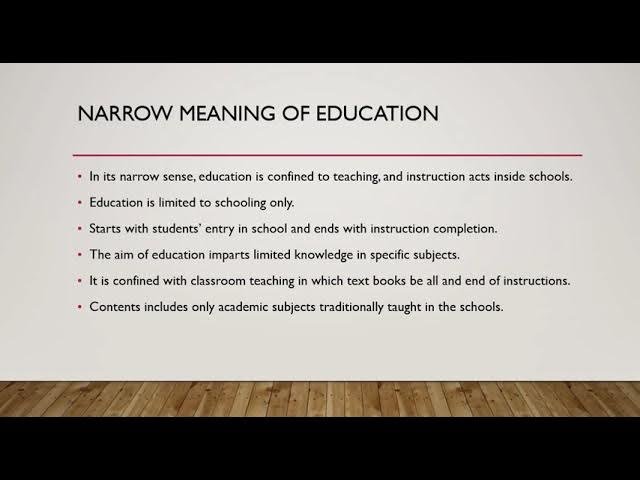
The term “narrow concept of education” describes the educational process that takes place in designated academic institutions that include schools, colleges, and universities. The educational process establishes its structured framework for teaching, which defines specific learning objectives together with predetermined educational content and scheduled instructional activities. The teaching staff delivers educational content to students by using an established teaching programthath contains predefined learning activities. The educational process begins at the moment when children start their school journey. The learning process continues until students finish their studies by either obtaining academic credits or receiving their degree. The students study mathematics, science, history, and literature as their core subjects.
The train operates on its designated track system. Narrow and Broad Concept of Education. The train moves along its established route until it arrives at its intended location. The educational system operates through its defined processes, which educators have constructed for learning purposes. It follows a structured route designed by educators.

Key Features of the Narrow and Broad Concept of Education
The essential elements of education need to be examined to achieve its narrow definition. The characteristics of formal education provide an explanation for its operational system. Education develops through its first method of prearranged educational execution. Schools follow a fixed timetable and curriculum. Students study different subjects according to a schedule. The second educational method operates through teacher control of the learning process. Teachers guide the learning process. They explain lessons to the students while they are doing their assignment,s and their performance gets assessed by their teachers. The third educational method establishes learning objectives. The system aims to develop knowledge and skills that help students pass exams and achieve academic success.
Understanding the Broad Concept of Education
The educational framework defines learning as a process that lasts throughout a person’s entire life. Educational activities extend beyond the confines of schools and the use of educational materials. The definition of education encompasses all experiences that lead to cognitive and character development in people.
The educational process starts at birth and continues throughout a person’s entire existence. Parents, friends, nature, culture, and societal norms provide people with learning opportunities. Important life lessons can be learned through everyday activities,s which include playing games and assisting with household tasks.
Scholars maintain that education exists in all its forms throughout the complete duration of human existence. Learning takes place in every circumstance because each situation presents educational opportunities. People acquire knowledge through their experiences of traveling, working, and engaging in conversations with others.
Children acquire speaking skills through natural observation. No teacher provides them with formal instruction about how to engage in conversations. They acquire conversational skills through family word repetition practice and maintaining daily listening routines. The natural learning process demonstrates educational functions through its existing natural educational system.
The Narrow and Broad Concept of Education includes complete personality development as its primary focus. The development process includes emotional growth, social development, moral advancement, and physical progress. Education functions as a method that enables individuals to achieve self-discovery and attain knowledge about their surroundings.

Key Characteristics of the Narrow and Broad Concept of Education
The broad concept of education includes several important characteristics that make it different from the narrow concept. Education exists as a continuous process that extends beyond formal learning, which ends after school and college. People continue learning throughout their lives. Learning can occur at home, in communities, at workplaces, and even through hobbies. The educational system develops all vital human abilities through its educational process. This method of education develops all human abilities through its educational process. The broad concept of education establishes learning through direct experience as its primary educational approach. People learn through real-life situations rather than only through books.
Narrow vs Broad Concept of Education
The difference between the narrow and broad concepts of education becomes clearer when we compare them side by side.
| Aspect | Narrow Concept of Education | Broad Concept of Education |
| Meaning | Formal schooling and instruction | Lifelong learning through life experiences |
| Place | Schools, colleges, institutions | Everywhere – home, society, workplace |
| Duration | Limited time period | Continues throughout life |
| Focus | Academic knowledge | Overall personality development |
| Method | Structured teaching and exams | Learning through experience and interaction |
This comparison shows that both concepts play important roles. Formal education builds academic knowledge, while life experiences develop practical wisdom.
Why Both Concepts of Education Matter
The belief exists that school education represents the only valuable educational experience. Narrow and Broad Concept of Education. The other perspective claims that people acquire their authentic knowledge through their life experiences. The reality states that both beliefs hold equal weight in importance. The narrow concept of education provides structure and discipline. Through schools, students acquire the ability to comprehend advanced mathematical, scientific, and technological knowledge. The existence of multiple professions depends on people who have achieved formal educational qualifications. Narrow and Broad Concept of Education The program develops skills in people to interact with others, to work together with others, to understand others, and to deal with difficult situations.
Postscript
The two essential methods for understanding learning exist in narrow and broad educational concepts. The Narrow and Broad Concept of Education focuses on formal schooling, structured teaching, and academic achievement. The process functions as a vital pathway for people to develop their professional competencies and intellectual abilities. The broad concept, however, views education as a lifelong journey. Learning occurs in all places, which include families, communities, workplaces, and daily life situations. Narrow and Broad Concept of Education. The combination of these components establishes the core foundation that makes up a person’s character and values and complete personality. The combination of both perspectives creates an educational system that delivers its maximum potential. responsibility.
FAQs
- What are the Narrow and Broad Concepts of Education?
The narrow concept of education refers to formal learning that happens in schools and institutions. The system includes planned teaching activities that follow a designated schedule and conduct exams to assess student performance.
- What is the broad concept of education?
The broad concept of education defines learning as a process that extends throughout a person’s entire life. The process includes learning experiences acquired through family relationships, social interactions, and daily activities.
- Why are the Narrow and Broad Concepts of Education important?
The broad concept supports the development of life skills, including communication, empathy, creativity, and critical thinking. The world requires these skills for people to achieve professional success.
- What is the main difference between narrow and broad education?
The narrow concept focuses on classroom instruction and formal knowledge. The broad concept includes all experiences that shape a person’s growth and personality.
- Can both concepts of education work together?
Yes. The two educational concepts need to be combined to establish a complete learning framework. Formal education builds knowledge, while life experiences develop practical wisdom.
Also Read: Medical Coding Institute in Vijayawada — A Clear & Friendly Guide