


What Is the Role of Education in Human Capital Formation?
Learning is a huge element in building skills in Human Capital Formation that we use a lot every day. It is like a combined bundle of skills we pick up, the expertise we gather, our previous reviews, and the kind of creativity that encourages us to handle tasks, earn a living, and yet we each get fulfilled. What we read begins to clarify the real part of who we are, as well as what we are capable of achieving, and periodically opens up even more possibilities for us later.
As we continue to study and grow, we begin to notice what we will undoubtedly do, and we could experience it quite effectively as well. So, by being curious to improve our skills and being patient, we are already continuing with the rotation, achieving our desired class by class.
Our mind is a bit like a young seedling, they need to be touched with pure thoughts to flourish at all, inside as a seedling wants sunlight and water to keep on its journey. Human Capital Formation: As we learn, we often discover strengths we weren’t aware of, and we also build more powerful units to make careful, more intelligent choices and take intentional small steps forward.
How Education Improves Human Capital Formation
After all, many studies of Human Capital Formation seem to rely on overarching cognitive models, such as summary common sense, problem solving, and useful knowledge as well. The program motivates this by guiding literacy skills involving mathematical numbers and refining spoken expression so it is clearer, somehow. In practice, this approach demonstrates primary methods of inquiry and techniques that help almost all different areas, even if the audience often does not see them at the beginning. Solid data handling combined with compound mental identity often moves a person towards fulfillment, greatly reducing resistance over the years.
These tools can then help humans make progress in school, the workplace, or even in everyday choices that just seem mundane. Of course, the information you have provides some security, or roots that anchor the tree against strong winds.
Why Education Matters for Economic Growth
Well, schooling shapes how we think about something deep, linked very closely to the whole cash-for-profit factor. Human Capital Formation: If the academies run the session, the markets survive the system and maintain it as it goes for a period of time. Smart people are a big part of it; They help with weights, they craft higher gears, they help others establish clever techniques, and yes, they push time forward. Really, based on our daily practices, progress often feels slow, like one percent of all of us.
Also take therapists, developers, and teachers, who start evolving from a long expansion of hard efforts and care. Without that kind of practice, dealing with annoying problems is almost impossible. Then their talent units spawn out and help those around them as best they can. As quality education becomes more accessible, sharp intelligence enters the labor market. This shift helps company growth, but it also creates new jobs.
Education Creates Better Opportunities: Human Capital Formation
For countless people, training in some way shapes their future outlook. Human Capital Formation: Knowledge comes in and fills the clean spaces where success did not show, and then new openings, quietly perhaps, but real when skills- what activities will establish better ways of doing things- begin to show, now not the easiest in theory, like distant daydreams anymore.
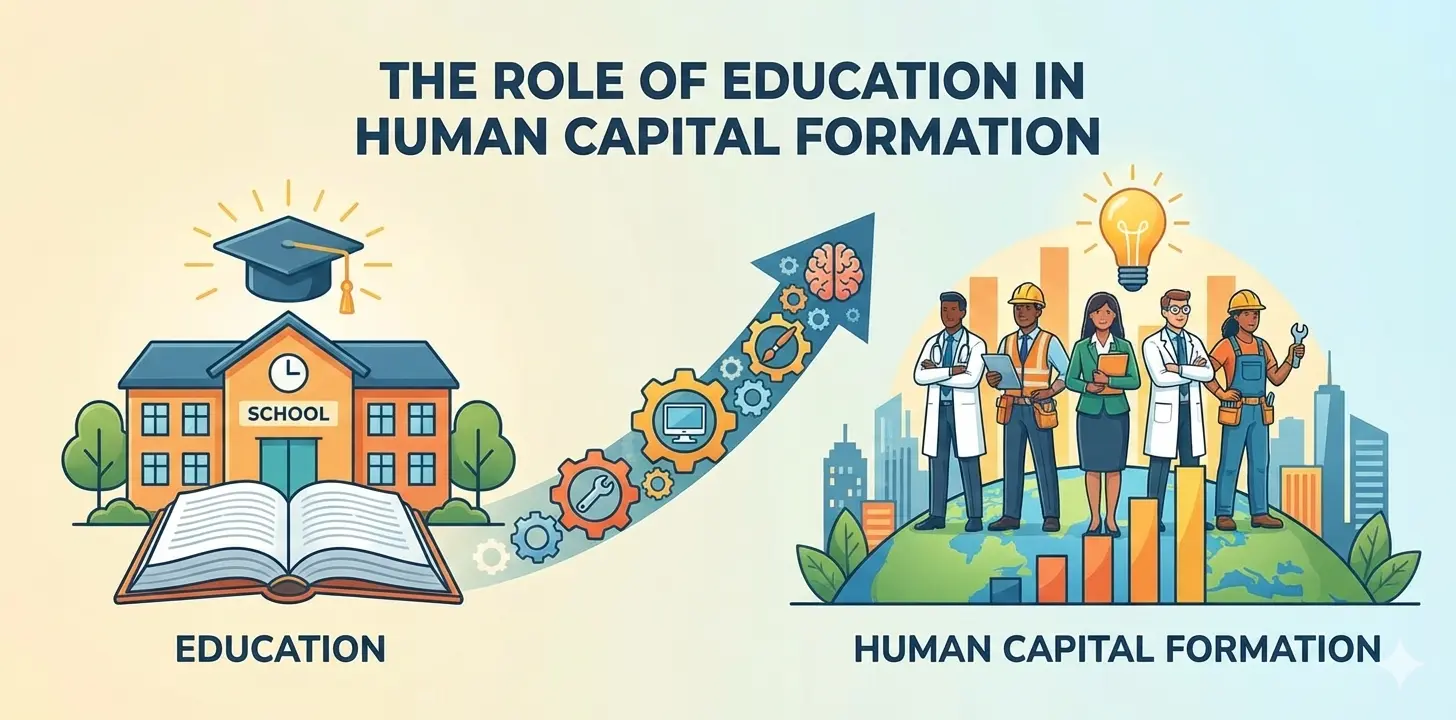
Consider, for example, a boy from a peaceful small village. With proper schooling, they can become doctors, sailors, and even business owners, because this pressure that shows the way to what is learned does not just happen by chance. It grows step by step as clues reveal doors they never knew existed. Information is being gathered piece by piece. What comes next, even if progress feels slow or like it’s going very softly, is right now.
The Social Benefits of Human Capital Formation Through Education
Education research is alive in a way that makes you realize that it goes beyond just who makes what money, or what their job title will be. When people start to master, they usually feel more responsible; they stick close to what they have achieved, and they see their responsibility a little clearer, maybe not immediately, but gradually. When you master enough, it becomes less difficult to do things you’re sure to remember.
When colleges share knowledge, things generally flow more equitably. That is the reason why humans can learn more deeply when trying out new query features, even slightly different concepts from themselves. Places where people learn a lot often emerge from seeing reduced crime costs, and hospitals can additionally observe that Human Capital Formation lives healthier lives.
When parents really understand how important expertise is, they usually get their children to attend the department. So skills built today end up helping what happens later. Sure, these adjustments may seem gradual, but they really accumulate over the years.
The Future of Human Capital Formation and Education
Now things are actually changing pretty quickly, right? Human Capital Formation: Every year, new gadgets pop up that no one saw coming, and occasionally, new ways to make money. So of course, it takes more to go to school and study than we might have previously thought. You can’t help but learn to live appropriately in your work; it’s just something you do all the time. If you’ve had to move before in your career and even as someone, you need to try to see what’s next.
It also allows you to learn about new things online that didn’t exist before. You can check with online sources without ever entering a study room. It’s so shocking: While the lifestyle is annoying, you don’t have to just be retarded to gain knowledge.

Synopsis
Education teaches Human Capital Formation people some statistics and realistic information every day, and it makes them feel more positive about themselves, as well as providing fresh perceptions. It is often associated with higher functions as well, promoting wise choices, encouraging parents to act responsibly, even as the teacher reassures her inner interests as she moves long after execution.
What is neat to overlook is that education also grows the economy, reduces poverty, and opens up opportunities that are considered inaccessible. People who often take on more identification lead to a more stable existence and help other people do better. So learning ends up being this quiet yet effective part that shapes life without all the noise. The actual progress shows up when each body obviously gets justifiable danger, not only said aloud, but also what they do every day.
Also Read: The Life-Changing Power of Education and Knowledge: Your Key to a Brighter Future